

Adrenocortical carcinoma (ACC) is a rare malignancy often with poor outcomes. It arises from the cortex of the adrenal gland with an estimated reported incidence in adults of 0.7-2.0 cases per million per year.1
ACC affects more women than men and has a bimodal age distribution with a peak before the age of 5 years and another peak in patients 40-60 years of age.2 Most cases of ACC occur sporadically, with a few being linked to genetic syndromes.2
 INCIDENCE
Incidence rate of
0.7 to 2.0
cases per million per year1
INCIDENCE
Incidence rate of
0.7 to 2.0
cases per million per year1
 AGE
Peak incidence between
40-60
years of age, but can occur at any age2
AGE
Peak incidence between
40-60
years of age, but can occur at any age2
 SEX
Females are affected
55%-60%
more frequently than males3
SEX
Females are affected
55%-60%
more frequently than males3
The presence of ACC is not always obvious.3
There are 3 main scenarios in which patients with ACC may present.4
In approximately 50%-60% of patients, symptoms related to excessive hormone secretion are the main reason for seeking medical attention. Biochemical hormone testing reveals that up to 60% of tumors are functioning (vs nonfunctioning).4
The second most common symptoms at time of initial presentation are unspecific abdominal symptoms, such as abdominal pain or fullness.4
While the likelihood of an adrenal incidentaloma being an ACC is low, an increasing number of cases are diagnosed within the group of incidentally discovered adrenal masses (incidentalomas).3
In addition to evaluating the clinical presentation of the patient and past and family medical history, initial evaluation is centered around detailed hormonal workup to reveal any excessive hormone production by the tumor (ie, is the tumor functioning vs nonfunctioning), which can serve as a tumor target during therapy.
Staging should include imaging of the primary site by computed tomography (CT) and/or magnetic resonance imaging (MRI) of the abdomen. Additional imaging may be performed if metastases are suspected. The final diagnosis is confirmed by a histopathologist.


Lysodren® is indicated for the treatment of patients with inoperable, functional or nonfunctional, adrenocortical carcinoma (ACC).
LEARN ABOUT Lysodren®Most patients with ACC present with advanced disease.5 Some patients with ACC may be diagnosed earlier from the use of improved imaging techniques.4
Several staging systems for ACC are in use, including the American Joint Committee on Cancer (AJCC) and the European Network for the Study of Adrenal Tumors (ENSAT), which is widely used internationally.
Staging Systems for ACC4,9
| AJCC* | ENSAT* | |
|---|---|---|
| Stage I | T1, N0, M0 | T1, N0, M0 |
| Stage II | T2, N0, M0 | T2, N0, M0 |
| Stage III | T1-T2, N1, M0 T3-T4, Any N, M0 | T1-T2, N1, M0 T3-T4, N0, M0 |
| Stage IV | Any T, Any N, M1 | Any T, N0-N1, M1 |
*Tumors are classified as follows: T1: tumor ≤5 cm; T2: tumor >5 cm; T3: infiltration into surrounding tissue; T4: tumor invasion into adjacent organs or venous tumor thrombus in vena cava or renal vein; N0: no positive lymph node; N1: positive lymph node; M0: no distant metastasis; M1: presence of distant metastasis.
ACC has a high recurrence rate with poor overall 5-year survival.5 The prognosis is, however, heterogeneous.3
Prognosis for ACC when treated10
The 5-year survival rate for ACC depends greatly on when the tumor is found.
The multidisciplinary team managing patients with ACC includes endocrinologists, specialized surgeons, medical and radiation oncologists, specialized pathologists, and genetic counselors. In addition to providing dedicated care to patients with ACC, these expert multidisciplinary teams exchange clinical and scientific information and may support broader patient engagement throughout the treatment journey.1
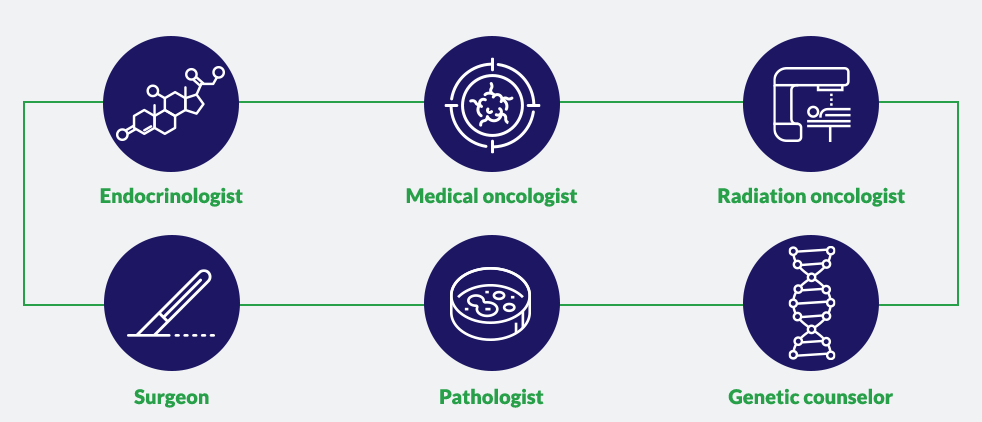
Nurses, pharmacists, mental health professionals, and other
healthcare providers are also involved in the management of ACC.
Complete surgical resection of the tumor is the only curative treatment option3 and is the treatment of choice for patients with stage I and II ACC.4 In stages III and IV ACC, in addition to surgical resection of the tumor if possible (stage III) and removal of localized metastases when appropriate (stage IV), Lysodren® with or without chemotherapy may be recommended.3

Lysodren provides links to web sites of other organizations in order to provide visitors with certain information. A link does not constitute an endorsement of content, viewpoint, policies, products or services of that web site. Once you link to another web site not maintained by Lysodren, you are subject to the terms and conditions of that web site, including but not limited to its privacy policy.
Click the link above to continue or CANCEL